Gender Equality in Tech. What can HR do? (Part 3)

woman in tech team

Gender Equality in Tech.
What can HR do?
PART 3

How to Retain Women

Rose McCarter-Field

By Rose McCarter-Field

Did you know that women are twice as likely to leave the technology sector than men? (1) Does this happen in your company? Research has shown that there is something about the STEM sector that is turning away talented women in increasing numbers (2).

It’s hard enough to find talented women to apply for tech jobs, why are they so keen to leave once they get here? I’ve been reading a number of commercial and scientific studies on the reason women leave STEM and I’d like to share some common threads in the findings. Perhaps in understanding these commonalities we can discover how to create a more gender inclusive industry.

Sadly misogyny is still a recorded issue, there is also a less blatant ‘lads’ culture that has been recorded to make women feel unwelcome at work. In part, this is day-to-day communications but it has also been found in many mentoring programmes and promotion processes. Have a look at how gender inclusive the promotion prospects in your company are. How many women do you have in managerial and leadership roles? If the answer is few, and your female staff are predominantly in entry level roles, then your career prospects are not gender inclusive. (See the next article where I focus on this, as it is a prevalent issue in STEM.)

Astoundingly, the gender pay gap is still an issue. A male computer programmer for instance will earn on average 11.6% more than their female counterpart. A female engineer will earn 18.7% less.  In contrast to other sectors, a male in education will earn 2.4% more, a male procurement specialist will earn 0.6% more. (4) … You get the idea. It’s not an issue isolated to STEM, but STEM notably underperforms when it comes to the gender pay gap. Until this is solved, talented women will be able to earn more in other industries. If your company hasn’t fixed this yet, I urge you to put this at the top of your to-do-list for creating a gender inclusive company. Having a transparent pay and rewards structure will go a long way to ironing out these unseen inequalities. 

Many women at some point feel inclined to choose a realistic balance between a career and family, so giving benefits that make balancing work and family life easier will help you keep your top female talent. Netflix offers parents of any gender up to a year off with full pay after the birth or adoption of a child (5). While Microsoft and Airbnb offer 22 weeks to new mums with full pay. (5) 

An estimated 22,000 women have failed to return to the engineering sector (5) following a career break. Some companies offer return to work programmes to help the move back into work, as well as fill the skills gap to ‘catch up’ with their male counterparts who haven’t had a career break. Alongside this, statutory parental leave now encourages new fathers to share childcare within the first year, enabling women to return to work earlier, if they would like to.

Many companies are embracing formalised flexible working policies, regardless of gender, as well as the option to work from home. This improves the quality of life for all employees, especially parents. It also enhances your appeal as an employer.

There are many factors affecting the gender balance in STEM. Aspects such as pay, an inclusive culture, career prospects and flexible working seem to have the biggest impact in balancing out gender equality. It’s important to also be aware that diversity without inclusion is a recipe for failure. Just having women in the team doesn’t mean you have an inclusive culture. You’ll need to cultivate and maintain an inclusive environment at all levels, for diversity to last. 

Sign up to Join the Digileaders Webinar: How Do We Get More Women in Tech? Practical Steps for Leaders

Part 4: How to Promote Women – coming soon! If you’d like this series of articles sent to your inbox, sign up here. Or come back in a week when I plan to post the next in the series.


    1. Forbes 2020 https://www.forbes.com/sites/joanmichelson2/2020/02/12/9-ways-to-recruit-and-promote-women-in-stem–from-the-cofounder-of-the-grace-hopper-conference/
    2. Rose McCater-Field 2021 https://dev.projectrecruit.com/why-has-gender-equality-not-improved-in-the-technology-sector-in-the-last-ten-years-and-why-is-it-now-getting-worse/
    3. Guardian 2019 https://www.theguardian.com/careers/2019/jun/26/how-changing-attitudes-are-closing-the-gender-gap-in-engineering
    4. Glassdoor 2019 https://www.glassdoor.com/research/app/uploads/sites/2/2019/03/Gender-Pay-Gap-2019-Research-Report-1.pdf
    5. WES https://www.wes.org.uk/sites/default/files/u102/Improving%20the%20recruitment%20of%20women%20in%20STEM_0.pdf 
    6. VOX 2018 https://www.vox.com/2018/1/31/16944976/new-parents-tech-companies-google-hp-facebook-twitter-netflix
Rose Laura Webinar Women in Tech

How Do We Get More Women in Tech?
Practical Steps for Leaders

A talk by Rose McCarter-Field and Laura West Project Recruit and Escalla

17th June 11.30am BST

Days
Hours
Minutes
Seconds

Send me stuff on women in tech!

Would you like our women in tech resources sent to you directly? Including women in tech articles and women in tech events, such as webinar invites.
Gender Equality in Tech. What can HR do? (Part 2)

woman in tech team

Gender Equality in Tech.
What can HR do?
PART 2

How to Recruit Women

Rose McCarter-Field

By Rose McCarter-Field

How often do you get a female applicant for a tech job? Surely all tech companies are mostly male, so it’s not just you? Tech giants and research groups have identified how tech companies are putting female talent off. And yes it is you, it’s actually all of STEM (science, technology, engineering, and maths) industries that have been found to have a culture that excludes women, right from the starting point, recruitment.

So what can we do? Research has shown that many women look at different facets of a company when looking for work. Women are more likely to be interested in culture, values, and work flexibility. Research such as those studies conducted by Akzo Nobel have found that engineering adverts, or adverts written by engineers often alienate women (1). They want to be able to see the life they would have working with you, not just technical terminology on tasks. 

Role Profiling 

What are managers and recruiters preconceptions about the type of character that will fit? Is this inclusive? Or is it ‘people like me’? If managers want to recruit ‘people like me’ or ‘people like Jo Blogs’ then you will never have an inclusive culture. It is important for managers to understand preconceptions about the type of person they want, and how that differs from the skills and attributes required to do a good job.

Job Adverts

Have a think about how you are advertising your roles. Are your adverts inclusive in their language and imagery? Do they use lots of cold technical terms? Where are the adverts being shown? Are any women seeing them? If you are head hunting, have you head hunted any women?

Women also don’t tend to apply for a job unless they have all of the skills listed on the job description, and extensive experience of those skills(2). Make sure you think carefully about which skills are essential for the role and clearly define your must-haves from your nice to haves; it will make the world of difference to the applications that come through.

Shortlisting

Research has also shown that women are more likely to be modest about their achievements in their application and in the interview. Be aware of this, especially in the interview process when asking interviewees about their experience. It helps to be clear about your shortlisting criteria, and place the onus on yourself to find the best match for this criteria. Try to get the best out of every interviewee by being inquisitive, that will give a fairer picture of the comparative experiences of applicants.

To aid inclusion in our recruitment, we need different perspectives on the table throughout all our processes, actions, and communications. That is how real inclusion comes about. But if that is not possible presently, we can take these basic steps to start the journey towards gender equality.

Sign up to Join the Digileaders Webinar: How Do We Get More Women in Tech? Practical Steps for Leaders

Part 3: How to  Retain Women – coming soon! If you’d like this series of articles sent to your inbox, sign up here. Or come back in a week when I plan to post the next in the series.

Afternote on Equality:

I find myself in a difficult situation not wanting to perpetuate any stereotypes by highlighting gender differences. Especially in a world where gender identity is no longer black and white. I can justify this by understanding that there really is a culture in STEM that is putting women off and we need to be aware of why this is, in order to achieve a better gender balance. There are so many talented people out there, and we want them to join us in STEM!

    1. Sunday Times 2014 http://thetim.es/1pjtvcI
    2. Forbes 2020 https://www.forbes.com/sites/joanmichelson2/2020/02/12/9-ways-to-recruit-and-promote-women-in-stem–from-the-cofounder-of-the-grace-hopper-conference/
    3. WES https://www.wes.org.uk/sites/default/files/u102/Improving%20the%20 recruitment%20of%20women%20in%20STEM_0.pdf
    4. Talent 101 2019 https://www.talent-101.com/blog/how-to-recruit-more-women-to-work-in-stem 
    5. Talent Works 2019 https://www.talent-works.com/2020/02/a-simple-guide-to-attracting-more-women-to-stem-roles/
    6. Glassdoor 2018 https://www.glassdoor.com/employers/blog/3-top-companies-strategies-for-hiring-retaining-women-in-stem/
    7. Glassdoor 2021 https://www.glassdoor.com/employers/blog/10-ways-remove-gender-bias-job-listings/ 
Rose Laura Webinar Women in Tech

How Do We Get More Women in Tech?
Practical Steps for Leaders

A talk by Rose McCarter-Field and Laura West Project Recruit and Escalla

17th June 11.30am BST

Days
Hours
Minutes
Seconds

Send me stuff on women in tech!

Would you like our women in tech resources sent to you directly? Including women in tech articles and women in tech events, such as webinar invites.

Gender Equality in Tech. What can HR do? (Part 1)

woman in tech team

Gender Equality in Tech.
What can HR do?
PART 1

Key Factors to Creating Gender Balance

Rose McCarter-Field

By Rose McCarter-Field

How many of your staff are female? For the past decade women in technology have accounted for 17% of staff(1). And in the UK, this minority percentage has started to decrease further (2).

What percentage of your job applicants are female? And what percentage of people applying for promotions are female? Recruiting, retaining, and promoting women in STEM (Science, Tech, Engineering, and Maths) doesn’t just happen. 

There are fundamental changes that have been proven to increase the RECRUITMENT, RETENTION and PROMOTION of talented women in STEM. These are the 3 aspects of creating a more gender balanced company that I will be exploring in this series of articles, and in my Digileaders webinar on the 17th June.

We have to start by recognising that we have created a culture that is not inclusive in the STEM sectors. The lack of women in STEM fields is a complex, multifaceted issue that requires persistent, long-term action. However, research has shown that there are tangible steps you can take to make a real difference now. Companies such as Nokia are taking these steps and seeing their talent pool open up to both genders.

Research has shown that everything from the wording in job descriptions to the nature of mentoring programmes has perpetuated the gender imbalance in STEM. These are tangible processes and communications that we can change. We can open up the talent pool to women. We just need to recognise how we are turning them away.

Sign up to Join the Digileaders Webinar: How Do We Get More Women in Tech? Practical Steps for Leaders

Part 2: How to Recruit Women – coming soon! Over the coming months I will be sharing a series of articles containing insights, ideas and tangible actions on how to recruit women in tech.  If you’d like this series sent to your inbox, sign up here. Or come back in a week when I plan to post the next in the series.


    1. Guardian 2020 https://www.theguardian.com/careers/2020/jan/02/ten-years-on-why-are-there-still-so-few-women-in-tech
    2. Rose McCarter-Field 2021 https://dev.projectrecruit.com/why-has-gender-equality-not-improved-in-the-technology-sector-in-the-last-ten-years-and-why-is-it-now-getting-worse/
    3. Forbes 2020 https://www.forbes.com/sites/joanmichelson2/2020/02/12/9-ways-to-recruit-and-promote-women-in-stem–from-the-cofounder-of-the-grace-hopper-conference/
    4. WES https://www.wes.org.uk/sites/default/files/u102/Improving%20the%20recruitment%20of%20women%20in%20STEM_0.pdf
    5. Talent 101 2019 https://www.talent-101.com/blog/how-to-recruit-more-women-to-work-in-stem 
    6. Talent Works 2019 https://www.talent-works.com/2020/02/a-simple-guide-to-attracting-more-women-to-stem-roles/
    7. Glassdoor 2018 https://www.glassdoor.com/employers/blog/3-top-companies-strategies-for-hiring-retaining-women-in-stem/
    8. Glassdoor 2021 https://www.glassdoor.com/employers/blog/10-ways-remove-gender-bias-job-listings/ 
Rose Laura Webinar Women in Tech

How Do We Get More Women in Tech?
Practical Steps for Leaders

A talk by Rose McCarter-Field and Laura West Project Recruit and Escalla

17th June 11.30am BST

Days
Hours
Minutes
Seconds

Send me stuff on women in tech!

Would you like our women in tech resources sent to you directly? Including women in tech articles and women in tech events, such as webinar invites.

10 Ways to Get Your Daughter Interested in STEM

girl looking at science and globe

10 Ways to Get Your Daughter Interested in STEM

And why it's important to start now.

Rose McCarter-Field

By Rose McCarter-Field

Why is it important for us to engage our daughters in STEM subjects?

When asked to draw a scientist, older children are twice as likely to draw a man than a woman.

The older the child is, the more likely they are to draw a man. The shift in results is triggered by girls becoming increasingly likely to draw a male scientist the older they get. A study of 20,000 students showed that 70% of 6 year old girls will draw a female, while only 25% of 16 year old girls do. Boys are more likely to draw male scientists at any age (3). Why are girls learning that science is associated with men, in a world where it no longer has to be?

Try it, ask your kids to draw a scientist and let me know what age they are and what happens.

Why are talented STEM girls not choosing STEM education?

In STEM sectors we are still finding the majority of applicants for jobs are men. But why? The majority of students in STEM are also male. Why?

Just before students get the chance to choose their specialist subjects, in their early-mid teens, there has been a recorded loss of interest from females in STEM (1). From this point on, the majority of STEM students are male. In the build up to this apparent loss of interest, girls perform equally well in STEM and have for many years. In some areas they perform better. So, why do they lose interest and drop the subjects?

The cause of this is not thought to be education. Though textbooks still predominantly feature pictures of men. Teachers are trying to counteract gender bias in the way they contextualise the subjects. For example, some teachers are making sure they use both genders in the way they describe real world examples of scientific theory. The cause is thought by many to be societal expectations and preconceptions.

Is there still a legacy of gender bias in our culture?

Do you remember The Bechdel Test? It was created to test the presence of women in movies. There are three simple measurements;

(1) The movie has to have at least 2 women.

(2) Those women have to talk to each other.

(3) The movie has to be about something other than a man.

If you watch a film from the 80s, you’ll be surprised how few movies pass the first 2 measurements.To date, about half of all films meet all 3 criteria.

We may have come a long way from the origins of The Bechdel Test. However, it doesn’t take a close look at TV to see how prevalent gender stereotypes are in our day-to-day life. Gender stereotypes are perpetuated in soap operas that feature girls struggling in science, and films that explore the discoveries of men that discount their female counterparts. (If you want more examples, see my previous article on Women Leaving Tech.)

As parents we want our children to be the best of themselves, and if that includes getting them into STEM, we need to counteract the discouraging message they are getting from our culture.

In the US, studies have shown girls start to lose interest in STEM as early as 8 years old. So the interest isn’t suddenly lost just before college. As parents, a curiosity in STEM needs to be built into how we play and interact with our daughters from a much younger age. We can normalise women in STEM and make it an option welcoming for women who will thrive in STEM.

10 Ways To Get Your Daughter Excited About STEM

Here are my top tips that I’m trying at home to get my daughter excited about STEM.

1

Experiment at home

There are many fun and visually exciting experiments you can try just with things in your home. There’s also a tonne of books out there such as 365 science experiments by Usborne that are fun learning activities. Here’s a video of experiments you can try with young kids to get them excited and curious about science on YouTube:

2

Find day-to-day hidden opportunities

Such as, how many forks do we need for two families of 4 people for the BBQ? Or look at different shaped clouds and research the impact of pressure systems on the weather. You can always Google for the answer and problem solve these day-to-day challenges with them.

3

Let them get to know the tool drawer, box or shed

Let them get comfortable handling and playing with tools. Just getting familiar handling tools makes a big difference. And why not get them involved in fixing things with you!

4

Encourage curiosity playing

For instance, what do you think is inside that discarded smartphone? Shall we have a look? You don’t need to know the answer, it’s curiosity that you are encouraging with this example.

5

Put their passions at the forefront of play and learning

If they love playing in the garden, find your science curiosities there. Tap into what gets them excited.

6

Share STEM stories

Share interesting STEM news with them, especially if there is a woman at the forefront. These can be current events or historical discoveries. Here is a book that I think looks inspirational, though we haven’t read it yet - Women in Science: 50 Fearless Pioneers Who Changed the World by Rachel Ignotofsky.

7

Encourage a growth mindset

Pick up on statements such as ‘I can’t do this’ and simply add ‘yet’. Change the mindset of ‘this is hard’ to ‘this is an opportunity to learn and discover’.

8

Watch your gender language

Especially when contextualising and summarising STEM learning. It is too easy to say ‘he’ as a default and not realise the connotations of this automatic gender link.

9

Encourage them to trust their instincts

A US case study showed that a group of high performing girls in New York underperformed in a multiple choice admissions test and as a result didn’t get a place at college. These girls were found to be less likely to make guesses and therefore underperform at multiple choice tests (1). Perhaps encourage the confidence to make an educated guess.

10

Don’t let your confidence affect them

Be aware that your reservations will be passed onto them. If you say something is hard, they will think it’s hard. If you don’t know the answer to a STEM question, see it as an opportunity to learn together. You might not be a pro scientist, programmer or mathematician, but that doesn’t mean you can’t get curious with your children.

If you try these at home, let me know how it goes. I don’t know if my daughter will be a STEM heroine one day, but I’m going to give her a chance to be, if it suits her.

    1. Keeping Girls in STEM: 3 Barriers, 3 Solutions, Edutopia 2019 https://www.edutopia.org/article/keeping-girls-stem-3-barriers-3-solutions
    2. 6 Things 
      Parents Can Do to Get Their Daughters Excited About STEM, Brightly https://www.readbrightly.com/things-parents-can-do-to-get-their-daughters-excited-about-stem/
    3. 50 Years of Children Drawing Scientists, Edutopia 2019 https://www.edutopia.org/article/50-years-children-drawing-scientists

Inspire the Next Generation of Talented Females

woman on mountain

Inspire the Next Generation of Talented Females

How sponsorship can reduce gender disparity and double the size of the talent pool in the technology sector.

Rose McCarter-Field

By Rose McCarter-Field

Does the male dominance of high profile figures in technology such as Elon Musk, Steve Jobs, and Jeff Bezos make the technology sector more appealing to men than women? Does the way we associate with the gender of high profile leaders have an impact on who we aspire to be? And in turn, reduce the number of women applying for technology roles?

Sponsoring women in technology is key to getting visible female leaders. These leaders have the ability to inspire the next generation of female talent. But, if we want to sponsor more talented women in technology, where do we find them?

The research in my last article on gender equality in technology showed that there is a higher probability of men receiving work related sponsorship than women. As a result, women are more likely to aim for careers in companies with high profile female leaders, where they can see career progression opportunities for themselves. Typically this means seeking careers outside the technology sector.

How do we get talented female leaders to inspire the next generation, if these women aren’t applying for technology roles? How do we encourage more female sponsorship in the workplace? And why are we not sponsoring the women we already have? Statistically speaking, if there are less women than men, then the probability of choosing a man for promotion is higher. But the numbers show a greater bias than statistical likelihood, with the majority of women being in entry level technology jobs. 

Research shows that we are more likely to sponsor and promote people with classically masculine attributes. See the research for this in my previous article.(1). And that these attributes can be used to successfully predict a person’s rise to leadership, but can not be used to predict the success of their performance as a leader. Research also shows that we favour people that remind us of ourselves. Neither of these biases help with our ability to choose the best person for a job. The Halo Effect (also known as the Halo Error) means that these biases make us more likely to assume intelligence in people fitting these preferred profiles. If people do not fit the preferred profile, they have to prove their talent more definitively to be seen as equally skilled.

Why do other sectors not seem to have the same level of gender bias? Why is technology so far behind on gender equality? If we want more talented women in technology we have to show them that it is possible for them to succeed. We need people of all genders in leadership to inspire the next generation. In turn, a more diverse leadership, allows less room for subconscious bias.

What can you do? If you are in a leadership position, next time you are looking to sponsor someone, consider your own biases. Consider sponsoring someone different to your usual profile. Perhaps even purposefully sponsor a talented woman to start breaking down the gender disparity. And whilst doing so, be aware that they will likely face sexism on this journey.

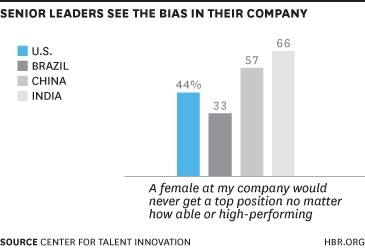
Research from Harvard Business Review showed that 44% of Senior Leaders agreed with the statement that ‘A female at my company would never get a top position no matter how able or high-performing’ (2). If half the people in the company think the woman you are sponsoring will not make it to a senior position, imagine the bias of ambitious people wanting to get to the top and how they might communicate with her differently to those that they think will get to the top. Just be aware of the day to day biases that will be faced, no matter how unintentional, and don’t let that stop you from sponsoring a woman. 

As an influential person leading us to the future of technology, it is in your power to make this change. To recognise the biases, to promote talented people of all genders. To empower people of all genders. You can change the statistics. 17% of people in technology are women and this number has been getting lower in the past year (1). If you want to see talented women in your company, you need to make the change.

Equally, if you are an ambitious woman, find yourself a mentor. Choose someone who sees and respects your talents and is keen to help you to achieve your goals. It doesn’t have to be someone in your company, it doesn’t have to be a woman. Find someone you respect and admire and ask! And check out PWC’s The Tech She Can® Charter.

Kamala Harris, America’s Vice President provided phenomenal strength to the 2020 US presidential campaign. She provided a younger, more vibrant personality. She was frightfully successful in political debates, as admitted by Joe Biden himself. She raised millions of dollars for political causes. She made a stand for transparency in leadership by making her tax returns publicly available. All these assets and actions gave the Democratic party strength. She also showed women, African Americans, Blacks, Asians, and Indians that they could succeed in American politics.

Sponsorship of the right woman can add strength to your leadership. By opening up to the other 50% of the population, you will double your talent pool. Show them they are welcome.

As a reminder of what is possible, here are just a few inspirational women working in technology today:

Joanna Shields, CEO of BenevolentAI: Uses AI to improve healthcare. US-born tech executive Joanna Shields is the CEO of BenevolentAI, a health-tech startup that aims to use AI to discover, test and ultimately develop new medicines.

Luciana Lixandru, Investor: Accel’s star young investor in London, helping start ups gain millions of pounds of funding (including Deliveroo).

Marta Krupinska, Entrepreneur: Marta set up a number of companies including being a cofounder of Azimo, the international money transfer platform which has raised $66 million to date. She is now helping Google champion new startups.

Bailey Kursar, Entrepreneur: Bailey puts ethics at the heart of money management. After cutting her teeth in marketing roles at the likes of Monzo, Zopa and Funding Options, entrepreneur Bailey Kursar decided to go it alone by founding Toucan, an ethically-minded money management app.

Safra A Catz, CEO of Oracle Corporation: Safra is an American billionaire banker and technology executive, now CEO of the Oracle Corporation.

Roshni Nadar Malhotra, Chairperson of HCL Technologies: Roshni is the first woman to lead a listed IT company in India. In 2019, she is ranked 54th on the Forbes World’s 100 Most Powerful Women list.

Wu Wei (Maggie Wu), CFO at Alibaba Group: Wu Wei is a Chinese business executive who is responsible for instituting Alibaba.com’s financial systems and organisation leading up to its initial public offering in Hong Kong in November 2007, as well as co-leading the privatisation of Alibaba.com in 2012.

Jennifer Morgan, an American technology executive: Jennifer is the first female chief executive of SAP, and she is the first female CEO of a company on the DAX index. She is the former Co-Chief Executive Officer at SAP SE. She became the first American woman ever appointed to the SAP executive board in 2017.

    1. Rose McCarter-Field, Why has gender equality not improved in the technology sector in the last ten years? And why is it now getting worse? https://www.linkedin.com/pulse/why-has-gender-equality-improved-technology-sector-mccarter-field/?trackingId=rAYAC%2B9YRZydSIg8biUXZQ%3D%3D 
    2. Harvard Business Review, What’s Holding Women Back https://hbr.org/2014/03/whats-holding-women-back-in-science-and-technology-industries
    3. Business Insider, UK Tech 100 https://www.businessinsider.com/uk-tech-100-2019-most-important-interesting-and-impactful-people-uk-tech-2019-9?r=US&IR=T
    4. 10 Women in Tech Leaders You Probably Haven’t Heard Of https://in.finance.yahoo.com/photos/10-women-who-lead-big-tech-and-youve-not-hear-of-them-111519616/amy-hood-executive-vice-president-000000691.html?guccounter=1&guce_referrer=aHR0cHM6Ly93d3cuZ29vZ2xlLmNvbS8&guce_referrer_sig=AQAAAEYHMTyEOjJ7CAvAp_ZYwtUk-sPmeP_JCIPTvLYm0v9W-jpYpd1jFBUO6a_hogE0COBI5XyrU5OduFMBGKifkjM3WOYy07l7JxKZJZ8-EnnfQD6V1RYv_XJPtN4NrMGDNaP49C-Xchim7bMtGNxvBh8tkMXe2Mb6O1qwAfMyGJVb
    5. Forbes, 50 Women Led Start Ups That Are Crushing Tech https://www.forbes.com/sites/allysonkapin/2019/02/20/50-women-led-startups-who-are-crushing-tech/?sh=66aa2de152b3
    6. PWC, The Tech She Can https://www.pwc.co.uk/who-we-are/women-in-technology/tech-she-can-charter.html 

Why has gender equality not improved in the technology sector in the last ten years? And why is it now getting worse?

woman in technology sector

Why has gender equality not improved in the technology sector in the last ten years?
And why is it now getting worse?

Technology is booming. Gender equality at an all time high. Why has gender disparity not improved in the technology sector in the last ten years? And why will there be further reductions of women in technology following the pandemic?

For the past decade women in technology have accounted for 17% of staff(3). While the world is improving it’s gender equality at work, more needs to be done to diversify the technology industry.

Rose McCarter-Field

By Rose McCarter-Field

In the UK alone, technology firms attract billions in venture capital funding every year. Technology is a fast growing innovative industry, continually creating new jobs and launching revolutionary products and services. Yet, while other industries across the world are improving their gender equality, at all levels, the technology industry seems to have stagnated. There has been no increase in female staff in the past 10 years.

The vast majority of job applicants in the technology sector are still male. Does part of the problem still start at school? Vanessa Vallely, founder of WeAreTechWomen, believes education is still a limiting factor in the connection between gender and the careers people aspire towards. Gender identity and how people identify careers that suit them, starts at a very young age. Even basic factors such as everyday language used to identify tasks as male or female have a significant influence on the roles people see themselves filling.

Perhaps the domination of male role models in technology is important? Mountain moving women such as Grace Hopper, The Queen of Code, have shown us that technology doesn’t have to be a man’s industry. Elon Musk, Mark Zuckerberg, and Jeff Bezos are the technology leaders inspiring our generation. But people are inspired into action by those they can relate to. Is it easier for a man to see himself as Elon Musk than a woman? And are women more likely to go into an industry with female role models, that they can more easily relate to? 

Research by Harvard Business Review shows that another part of the challenge is women leaving the industry soon after joining. Women working in science, engineering and technology (SET) fields in the U.S. are 45% more likely to quit the industry within a year of starting than their male counterparts(5). The reasons for such a high rate of women leaving the industry so quickly is not certain. Though a lack of sponsorship from people in senior positions has been identified as one significant factor(3). Career progression is often accompanied by internal support and sponsorship is often triggered by a leader seeing something of themselves in a younger person. However, the people in senior positions are typically men. If they want gender equality, these leaders need to sponsor people of all genders to support their progression.

Overt misogyny is sadly still prevalent. There is also the less obvious and often unintentional day-to-day gender bias. Maddy Cross, talent director of Notion, which specialises in investing in technology businesses, thinks men in authority still have a huge role to play in changing attitudes and culture(3).“… micro-sexism happen[s] in business every day,” Cross says(3). Until there is gender equality in leadership, it will be difficult to break down cultures of sexism. And until gender equality is a reality in the workplace, it will be difficult to identify and confront sexist behaviours.

It may not just be externally imposed sexism in the workplace that is the cause of the gender disparity. Nicola Anderson, Chief Marketing Officer at MyTutor, has found that women in technology often won’t apply for a job if they don’t feel they have exactly the right experience(3). As a result, women are hesitating more than men to put themselves forward for promotion. This same self-hindering behaviour has been reported in other industries(11). Why are women more likely to hesitate? I do not believe it is a lack of ambition or determination. 

The Harvard Business Review’s report found a culture in SET that made women feel isolated. When 72% of SET women perceive a bias in performance evaluation, it is no surprise that they might hesitate to apply for promotion. Nearly one-third of senior leaders in the U.S. and more than half in China and India expressed a belief that a woman would never achieve a top position at their company, no matter how able or high-performing. 

chart showing data on women in tech

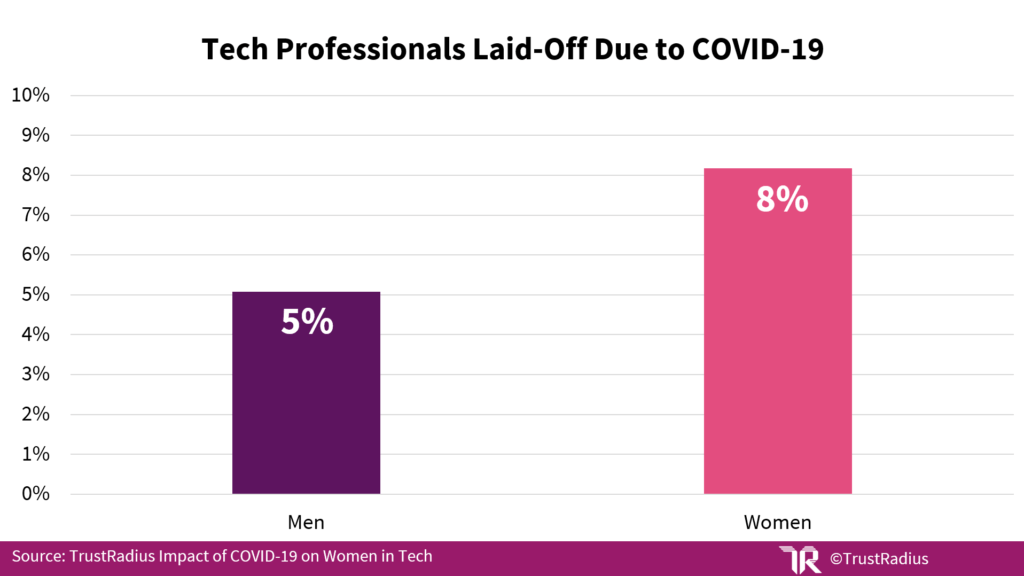
The 2020 TrustRadius Women in Tech Report included 600 tech professionals, including 270 women, 315 men, 5 non-binary respondents, and 6 respondents who chose to not identify their gender. The report found that as a result of the COVID-19 pandemic, women in technology are 1.6 times more likely to be laid off or furloughed than their male counterparts. This gender disparity has been identified as a consequence of women being more likely to hold entry level jobs and junior positions4. As a result, in the coming months, we could see the striking 83% male dominance of the technology sector increase even further. Furthermore, Stephen Rooney, Director of STEM Women, reports that diversity initiatives are being put on hold while companies respond to the pandemic.

chart showing data on women in tech

Despite the Equal Pay Act, the gender pay gap is a persistent issue. Glassdoor research in the U.S. shows women in the technology industry earning 94.6 cents for every dollar earned by a man(2). Whereas in Biotech and Pharmaceuticals women earn 97.8 cents for every dollar earned by a man. This is a challenge across all sectors and the technology sector comes below average, which is another deterring factor for women joining the industry.

In the 60s Dame Steve Shirley cheated the overt gender bias of her time. She was a coding legend and philanthropist who changed her name from ‘Stephanie’ to ‘Steve’ to aid her career. When she signed business letters as ‘Steve’ rather than ‘Stephanie’ she started to get responses and found trading was made possible. She hired hundreds of female programmers to work on projects such as programming the Concorde’s black box flight recorder, all under her adopted masculine name ‘Steve’. Though gender equality has improved greatly since the 60s, arguably not so much in the technology sector.

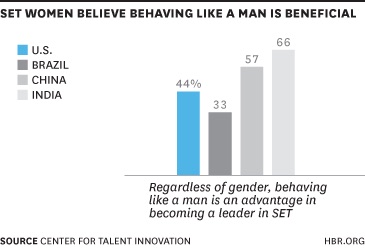
Harvard Business Review research shows that regardless of gender, behaving like a man is still beneficial in progressing one’s career in SET. Multiple studies show that classic male attributes such as a low voice, being tall, and having a symmetrical chiselled jaw are still an effective means to predict a person’s rise into a leadership position [examples: Business Insider(1) & Psychology Today(6)]. There is however no link between these attributes and predicting a person’s effectiveness as a leader.

chart showing data on women in tech

Our experiences tell us that a person in SET is more likely to be male and that someone with stereotypically masculine attributes is more likely to be promoted. Historically, the success of women in these fields has been shadowed by their male counterparts. Marie Curie’s first Nobel Prize nomination was initially awarded to her husband. Our experience makes it easier to instinctively imagine a successful male in these roles. Until gender equality becomes the norm, our inbuilt stereotypes and conscious or subconscious biases will not change. Until we have a real mix of types of people across all roles in the technology industry, breaking down current ‘masculine’ stereotypes, we can not break this inbuilt bias.

It is up to the leaders in technology to notice the extent of the gender equality in their company, to sponsor and promote skilled people of all genders. It is up to the leaders in technology to understand and breakdown their own biases towards stereotypically male behaviours. We need to see people of all genders excelling, with their own personalities, not having to become masculine to succeed. 

Ruth Bader Ginsburg “I’m sometimes asked when will there be enough [women on the supreme court] and I say, ‘when there are nine,’ people are shocked. But they’d been nine men, and nobody’s ever raised a question about that.”

As a reminder of what is possible, here are just a few inspirational women that have changed history:

Jane Goodall: Jane’s research in chimpanzees triggered a redefinition of the term ‘human’.

Florence Nightingale: A pioneer in data visualisation with the use of infographics, effectively using graphical presentations of statistical data. As well as being “The Lady with the Lamp”.

Margaret Hamilton: An American computer scientist, systems engineer, and business owner. She was director of the Software Engineering Division of the MIT Instrumentation Laboratory, which developed on-board flight software for NASA’s Apollo program.

Sally Ride: An American astronaut and physicist. Born in Los Angeles, she joined NASA in 1978 and became the first American woman in space in 1983.

Grace Hopper: “The Queen of Code” An American computer scientist and United States Navy rear admiral. One of the first programmers of the Harvard Mark I computer, she was a pioneer of computer programming who invented one of the first linkers.

Valentina Tereshkova: Engineer and former cosmonaut. The first and youngest woman to have flown in space with a solo mission on the Vostok 6 on 16 June 1963.

Mae Jemison: An American engineer, physician, and former NASA astronaut. She became the first black woman to travel into space when she served as a mission specialist aboard the Space Shuttle Endeavour.

Dame Stephanie “Steve” Shirley: IT pioneer, businesswoman and philanthropist. Steve founded the Xansa plc software company, who hired hundreds of female programmers.

    1. Business Insider 2014 https://www.businessinsider.com/physical-attributes-of-leaders-2014-10?r=US&IR=T
    2. Glassdoor 2019 https://www.glassdoor.com/research/app/uploads/sites/2/2019/03/Gender-Pay-Gap-2019-Research-Report-1.pdf 
    3. Guardian 2020 https://www.theguardian.com/careers/2020/jan/02/ten-years-on-why-are-there-still-so-few-women-in-tech 
    4. Guardian 2020 https://www.theguardian.com/careers/2020/jun/18/everything-has-been-pushed-back-how-covid-19-is-dampening-techs-drive-for-gender-parity
    5. Harvard Business Review 2014 https://hbr.org/2014/03/whats-holding-women-back-in-science-and-technology-industries 
    6. Phycology Today 2017 https://www.psychologytoday.com/us/blog/talking-apes/201708/the-look-leader 
    7. STEMWOMEN 2021 https://www.stemwomen.co.uk
    8. TrustRadius Report 2020  https://www.trustradius.com/buyer-blog/women-in-tech-report
    9. TrustRadius Report update 2020 (post COVID) – https://www.trustradius.com/vendor-blog/covid-19-women-in-tech
    10. WeAreTechWomen 2020 https://wearetechwomen.com 
    11. Women and Higher Education Leadership 2013 https://www.ses.unam.mx/curso2015/pdf/23oct-Morley.pdf 

Lessons from IR35 in the Public Sector and What it Means for the Private Sector in 2021

IR35 man leader

Lessons from IR35 in the Public Sector and What it Means for the Private Sector in 2021

A flexible workforce is fundamental to successful business investment and economic growth. Is IR35 damaging the health of our economy and ability to recover from the current crisis?

Rose McCarter-Field

By Rose McCarter-Field

IR35 is designed to identify contractors who are avoiding paying the appropriate tax by working as ‘disguised’ employees, often through a Personal Service Company. However, the revised legislation inadvertently damages individual workers, business innovation and growth as well as our economy.

IR35 shows a one-size-fits-all approach from the Government which has been devastating to the public sector and in April next year is due to cause similar damage to the private sector. In an attempt to clamp down on tax avoidance, the legislation fails to consider the diversity of companies that drive our economy.

“Inside IR35” decisions make contractors more expensive, because employers’ National Insurance will be due. At the same time, the contractor’s take-home pay reduces, due to the deduction of PAYE tax and NICs. IR35 can reduce the worker’s net income by up to 25%, costing the typical limited company contractor thousands of pounds in additional income tax and NICs. 

Any business forcing genuinely independent contractors inside IR35 is unnecessarily increasing their costs, while restricting their access to skilled workers. Since the implementation of the revised IR35 regulations in the public sector, they have been struggling to attract and keep hold of talented contractors.

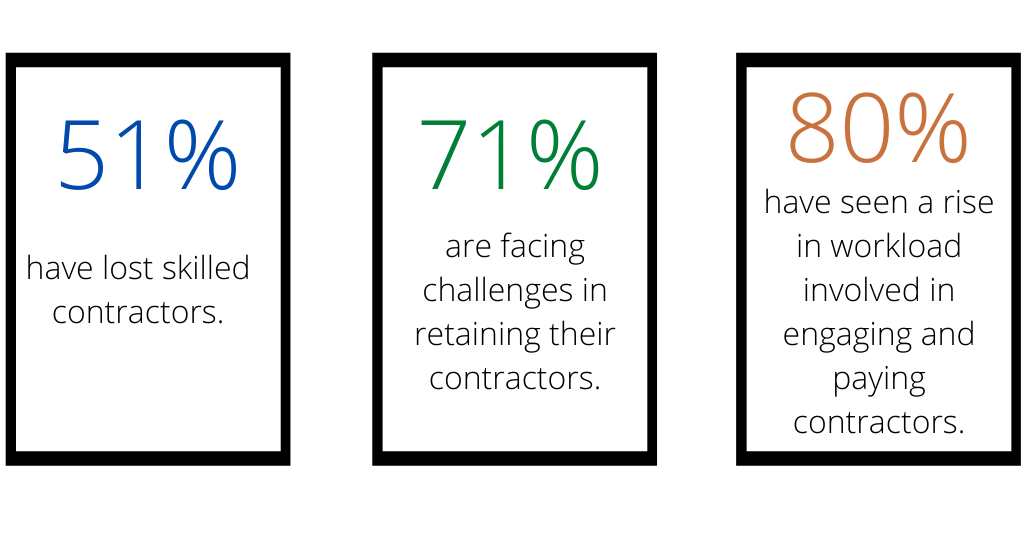
A study by the CIPD and IPSE (Association for the Independent Professionals and the Self-Employed), found that 51% of public sector hiring managers thought they had lost skilled contractors because of these changes that were implemented in 2017. A further 71% are facing challenges in retaining their contractors.(1)

graphic on IR35 impact

A study by the CIPD and IPSE (Association for the Independent Professionals and the Self-Employed). The impact of the revised IR35 legislation on public sector hiring managers.(1) 

Transport for London (TfL) projects rely heavily on contractors affected by IR35. TfL have experienced significant delays as a direct result of these regulatory changes. Chris Bryce, IPSE’s chief executive describes IR35 as “deeply flawed”. He reports that the legislation is damaging projects and people for whom the IR35 changes are not designed. These are not tax dodgers, they are people running innovative projects that drive our country and help our economy to grow.

Charles Cotton, senior performance and reward adviser at the CIPD, said the research suggested the IR35 amendments had resulted in “damaging unintended consequences” for the public sector. With the roll out of these changes into the private sector we can expect to see similar damaging effects.

“HR professionals have said they are finding it harder to recruit and retain skilled contractors, which is contributing to project cost rises, projects being delayed and, in some cases, projects even being cancelled,” Charles Cotton, senior performance and reward adviser at the CIPD.(1)

With a significant increase in unemployment levels and the introduction of furlough this year, our economy needs innovation to survive. The UK has furloughed more than any other country, our highest levels of furlough reaching nearly 30% of our workforce(2). Many of these jobs will become obsolete or significantly change in the coming months. 

People will be made redundant and they will have the option to return to the market selling their skills as freelancers or to retrain and develop their skills in new fields and start new businesses. IR35 restricts the attraction of this and furlough payments suppress the need for companies to make the difficult but inevitable decision now. In the US where the government has paid money directly to workers who have lost their jobs, they have created earnings breathing space for people to start up new businesses. As a result, there has been a record number of new companies popping up. Whether training yourself in a new skill or offering your skills out as a freelancer, tax law should be progressive and encourage this not punish it. It should not make companies afraid of engaging with small businesses.

Out of a recession comes innovation. Microsoft, Hewlett Packard, Amazon, Apple, Google, and Disney all started in a garage and are now worth more than the GDP of the entire UK economy. Government legislation should not be restricting our ability to invest and innovate, it should be encouraging us to do so. 

The global marketplace has dramatically changed in a very short space of time. We live in a new, digitised and socially distant marketplace. Companies and people need to adapt, fast. It is up to the Government to support any opportunity for innovation and investment. The faster we adapt, the faster our economy will recover. A flexible workforce is fundamental to this recovery.


    1. People Management https://www.peoplemanagement.co.uk/news/articles/ir35-damaging-unintended-consequences-
    2. public-sector-employers
      The Economist https://www.economist.com/leaders/2020/10/29/why-rishi-got-it-wrong

How To Love The Job You Already Have

job searching woman in tech and IT

How To Love The Job You Already Have

Recruitment was something that I ‘fell into,’ like most people I know in the industry.

I spent the first five years of my career routinely swinging between different possible exit strategies. I would drop everything and travel, or enrol in a Master’s degree, or become a secondary school teacher, a physiotherapist, a marketer, an accountant, an astronaut. Name a profession, and I had probably spent a few hours Googling ways that I could get into it.

Ngaire Wallace Profile

By NGAIRE WALLACE

Recruitment was something that I ‘fell into,’ like most people I know in the industry.

For the most part, I enjoyed my job. The pay was good, my colleagues were a decent bunch and the rough edges were smoothed over by generous performance bonuses and a well-stocked staff wine fridge that we routinely emptied every Friday.

Nonetheless, I spent the first five years of my career routinely swinging between different possible exit strategies. I would drop everything and travel, or enrol in a Master’s degree, or become a secondary school teacher, a physiotherapist, a marketer, an accountant, an astronaut. Name a profession, and I had probably spent a few hours Googling ways that I could get into it.

I didn’t mind what I did for a living. But I always felt that somewhere out there, at the other end of an imaginary career development rainbow, was ‘the job’ – the vocation that I was destined to have. In my mind, recruitment wasn’t it.

That all changed in a heartbeat in September 2008, when Lehman Brothers collapsed and the bubble of the City’s financial services industry burst along with it. Suddenly my evening Metro was full of pictures of be-suited office workers walking out of their glass towers with their worldly possessions in archiving boxes and job applicants were calling my desk line to make a general enquiry between floods of tears. My two biggest clients made sweeping redundancies that same week, and my entire desk was wiped out. Clients became candidates as the HR representatives and internal recruiters for whom I recruited lost their jobs.

Since my job was filling other jobs, and very few of those were now around, it was a miracle that I still had one. From that moment, and for the next two years as I managed to cling onto the job I had until the market turned around, I loved every moment that I was gainfully employed, and I’ve loved it ever since.

Hopefully you won’t need to experience the fear of redundancy or a recession as a catalyst, but there’s all sorts of reasons why staying in your current job, and making it a better place to be, might be a better career move than finding a new one.

You might have a patchy CV history and need a longer stint in your current job before looking at a move. Maybe you are nearing a step up in seniority and you need to stay where you are and get a promotion before moving on at that level. Perhaps you are lucky enough to be paid over the market rate in your current role, or the circumstances of your job might suit you, like flexi-time or a short commute. Whatever the reason, if you are stuck where you are for now, here are 11 ways to make it better before you fall back on ‘grin and bear it’.

  • Change your attitude. It might be hard to hear, but if you have a habit of hating your jobs, it may be that the problem is you. You have two choices here – carry on and be miserable, or talk yourself out of hating your job. How to make that happen? Write a list of all the things that you enjoy about your job, and another of all the things you don’t like. Go through the ‘don’t like’ list, and cross out anything that could be improved, delegated, or simply doesn’t need to be done. Go through the ‘love list’ and highlight anything you could incorporate more of. Perhaps there’s something you can trade. For example, if you love sales but hate spreadsheets, can you negotiate a task swap with a tech-friendly colleague?
  • Change your job – or at least, one task. Even the most motivated person can become stuck in a rut, especially if they have been in a cycle of ‘same old’ for so long that every day feels like ground hog day. Even the smallest step forward – such as embracing a new technology, or absorbing new information from a webinar or training course – can help to put a spring in your step.
  • Change your environment. When was the last time you cleaned your desk? Cleared out your old files? Take some time to clear your inbox, straighten out your paperwork and put a motivating image on your desk top. Your spruced up environment will give others the impression that you care more, and their positive impression of you will no doubt make your working life easier (and maybe make that promotion come quicker).
  • Change your colleagues. Okay, so maybe this one isn’t so easy. Entrepreneur Jim Rohn is famed for saying “you are the average of the five people you spend the most time with,” and considering how much time the average person spends at work, this number probably includes your workmates. Maybe you love them, maybe you hate them, and maybe you’re stuck with them either way. Try adding to your inner circle of influence by using networking sites such as LinkedIn and Twitter to connect with professionals in your industry and gain exposure to new ideas, methodology and enthusiasm for your profession that you might not be finding on your team. Attend local networking and business events. Arrange to meet up with entrepreneurs in your industry – anyone who is running their own business is almost certain to be full of passion for work that will hopefully rub off on you.
  • Change your attitude to your colleagues. How well do you know them really? Maybe if you invited Ted from accounts or Sarah from I.T out for a beer or a walk over lunch you might find that they had a good reason to turn down your recent request for a new client credit limit waiver or a hardware upgrade. Perhaps you can bond over the fact that you both hate your jobs. A sense of community can be a great antidote to an unfulfilling job. Even the most painful of tasks fly by when you are working with a team that you love. Even if it seems painful at first, join your company sports team or poker night and try to build relationships. You spend five days a week with these people, you may as well try to enjoy their company.
  • Volunteer for something new. If for practical reasons, your manager doesn’t have the budget to send you on a training course, or any new work to offer you in place of your existing tasks, why not offer to attend training or complete an extra project in your own time? Sure, you will be working for free for as long as that takes – but you will learn new skills and gain new experience during that time, and your employer may be so impressed with your willingness to change that the next time a new project comes around, you may win it. At the worst, you can always add it to your CV.
  • Work pro bono for a charity. If you feel like the corporate grindstone is paying your bills but sucking out your soul, but you can’t afford to work in the public or charity sector (or you haven’t been able to land a job in this area) then try giving away your skills for free. Volunteering for a good cause is bound to make you feel good, and seeing your skills and experience actually helping someone in real-time may make you feel a whole lot better about what you do day to day.
  • Do something you enjoy outside work. Skip Friday work drinks, and take the salsa dancing or taxidermy course that you have been dreaming about. A rewarding life outside work will make you a happier person to be around in the office, and give you something to look forward to when the clock strikes home-time.
  • Take a holiday. Sometimes the best way to get over a bad week at work is to take a week off. If you can’t afford a sun-filled off-shore extravaganza, just take a day off and spend it being a tourist in your own town. A holiday might be as good as a change.
  • Update your CV. You don’t need to use it, but seeing all your skills, experience and achievements written down will bolster your confidence, and if you are considered for a promotion, you will be able to immediately summarise why you are the best person for it, and why you deserve a raise at the same time. Checking out the job market, even without the intention of changing jobs, will enable you to identify what skills you lack in comparison to your peers, and you can use this information to flesh out your skill set and knowledge base with targeted learning. And, you’ll be safe knowing that if the perfect position with another company does pop up, you can fire off an application immediately.  
  • Adjust your expectations. There’s a million blogs, self-help books and YouTube videos telling us all about how to create the perfect life and the dream career. The truth is that none of us will ever be perfect, and even the best jobs are awful at least some of the time (while I’m at it, detoxes are a myth, and kale tastes dreadful). Chances are that even though you feel stuck in the doldrums right now, things will pick up in time. 

How To Answer ‘Where Do You See Yourself In Five Years’ Time?’

mature and young candidates for job

How To Answer ‘Where Do You See Yourself In Five Years’ Time?’

Career coach, writer and entrepreneur Emile Wapnick opened her excellent TED talk ‘Why some of us don’t have one true calling’ by posing the question: “How many of you have been asked ‘what do you want to be when you grow up?”

Ngaire Wallace Profile

By NGAIRE WALLACE

Putting aside for now whether or not we do have one (or more) true calling/s, how to re-write your CV once you find yours and want to move into it, and what to do if you have no idea where to start – which I will address in future posts – let’s take a look at how to respond to the ‘grown up’ version of this question that arises time and again in interviews: “Where do you see yourself in five years’ time?”

As a job-seeker, you may roll your eyes inwardly each time you are asked this. As an interviewer, I internally cringe whenever I ask it. Cliché or not, it is a question will continue to arise and is likely to have a major influence on whether you land the job of your dreams (or any job at all).  

The key to a successful response is empathy.

Consider “Why is my interviewer asking this question?” Or, in other words, “what do they want to hear?”

Imagine the following scenario:

You are meeting your Tinder crush for the first time. Over a pint of your favourite bitter (or a crisp glass of rosé), the script of a B-grade movie strikes and you are suddenly gifted the ability to read your date’s thoughts. Hoping for an ego boost, and a clue as to whether they might be ‘the one,’ you gently probe to find out why, out of all their other ‘swipe rights,’ they chose to spend a Tuesday evening with you.

Now, which of these two outcomes would make you more likely to see that person again?

One: You discover that after their initial attraction to your homepage your date has read your profile in detail, identified with your fondness for obscure anime and your passion for dancing poorly to eighties’ ballads, and hopes that an introductory meeting may lead to establishing a mutually beneficial relationship.

Two: Your date has not bothered to click beyond your picture. They were already sold on your convenient location and immediate availability, and frankly, they’ll consider dating anyone who meets certain basic criteria. Winter is coming and they’d quite like to not be single, at least from November to February.

Job searching is much like dating. Like any ordinary human, your interviewer wants to know that you have chosen them, and that you specifically want what they are offering. They do not want to feel like you turned up simply because their office is on the Northern line and Google didn’t call back.  

You may think that the ‘where do you see yourself’ question is the fodder of inexperienced interviewers or a death knell that signals the interviewer has made their mind up already and is just scratching to fill a lull in conversation, but in fact, the answer to this question gives valuable insight into an applicant’s aspirations, level of commitment, likely level of engagement in the role, background research, and plain old common sense. If I had a pound for every person who applied for a job as an accountant and then told me they want to work in sales, I would have at least a quarter of a London flat deposit by now. 

TL;DR: Save the fact that you still don’t know what to do with your life – or that in five years’ time you see yourself drinking a margarita on a beach in Hawaii – for TED talks and your friends in the pub. In your next interview, impress your potential future employer with your in-depth knowledge of their company, product, values and culture, and tell them that the job they have on offer is a perfect, and logical next stepping stone in your planned career path. Help them to believe that this is your dream job, and consequently, hiring you is in their organisation’s best interests.

However, remember that even the best metaphors have their limits – don’t tell your next internet date that in five years’ time you see yourself settled down with them, and possibly in a Management position, or you may find yourself facing an very early retirement.